
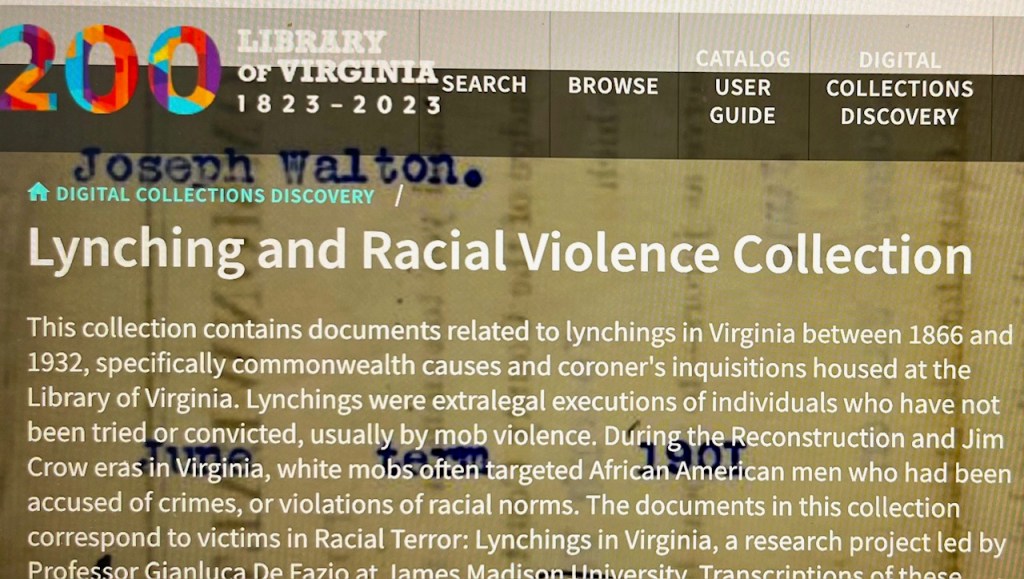
Researchers who study lynchings in Virginia have a new database to work with.
The Lynching and Racial Violence Collection went online in May. It is a collaboration of the Library of Virginia and Gianluca De Fazio, an associate professor of justice studies at James Madison University.
The collection spans 1866-1932 and includes court records and other lynching documents housed at the Library of Virginia.
When I learned of the new database, I immediately entered the names of Arthur Jordan and Shedrick Thompson into its search function. The two are the subjects of books I have written. I found nothing about either man, but that’s no surprise.
As De Fazio has written, “Archival sources on lynching are relatively rare, as most of the time there were no official records that a lynching took place.”
Even so, the database contains a remarkable assortment of material. Archivists at the Library of Virginia digitized the pages, and teams of undergraduate students at JMU transcribed the often difficult handwriting.
The material includes warrants, summonses, subpoenas, indictments, death certificates, witness testimony and jury verdicts.
For example, the database has more than 100 pages of court documents from the 1891-92 cases of Lee Heflin and Joseph Dye. The two men were lynched in Gainesville after being convicted of murder in Fauquier County.
The new database is yet another effort to document an overlooked chapter in Virginia history. As De Fazio wrote, it is part of “a larger scholarly and public effort to reveal and examine the history and extent of racial violence in the United States.”
The database is housed at the Library of Virginia’s website here. Links to individual victims can be found within De Fazio’s Racial Terror: Lynching in Virginia website. De Fazio has written here about the collaboration between him and his students and the library staff.
I will be giving a presentation at the Rose Library at James Madison University on Thursday, Jan. 25, 2024, at 3 p.m. I also will be speaking to some of Prof. De Fazio’s students prior to the public talk.
 Jim Hall