
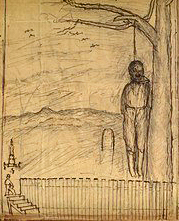
One of the curious features of Dr. Augustus Horner’s drawing of the Arthur Jordan lynching is his placement of a single tombstone in his sketch.
A single tombstone in the Warrenton Cemetery? The place is enormous. Perhaps Horner meant it as representative of the many other markers there. No, Horner drew what he saw.
If you inspect the tombstones on the hillside beside the Confederate Memorial—those that would have been in Horner’s line of sight—you’ll find only one that dates to before 1880, when Jordan died. That is the grave of James Deshields.
Deshields was 54 when he died of typhus in 1862. He was a native of Maryland and resident of Warrenton. He was survived by his wife Eliza and their six children.
Deshields operated the Warrenton House hotel for several years. His obituary describes how he was known for his hospitality, and how his friends enjoyed his table of plenty “from noon until night” on court days.
Years later Deshields’ grave was silent witness to a murder. It also testifies to the accuracy of one of the few relics of Jordan’s lynching—Horner’s drawing.
 Jim Hall