
There are more than 8,000 graves in the Warrenton Cemetery, but none is as popular as the grave of Col. John S. Mosby.
Mosby’s grave is a place of pilgrimage, a tribute to the famed soldier. And I don’t understand why.

Mosby was a legendary Confederate cavalry officer, the “Gray Ghost,” whose guerrilla tactics bedeviled the enemy during the Civil War. He was David taunting the Union Army Goliath.
Mosby died in 1916 at the age of 82. He and other family members are buried in a prominent spot in the 18-acre Fauquier County cemetery. His grave is beside the Confederal Memorial, the marble spire that is the cemetery’s most famous landmark. His grave is also a few yards from the spot where Arthur Jordan was lynched.
Mosby was 44 when Jordan died. He was living in Hong Kong, serving as U.S. consul, so he may not have heard about the murder. We have no record of any reaction on his part.
However, we do have modern-day reaction to Mosby himself. His grave is adorned as no other in the cemetery, framed by the “Stars and Bars,” a flag of the Confederate States of America. Coins and medals, left by admirers, dress the top of his tombstone.
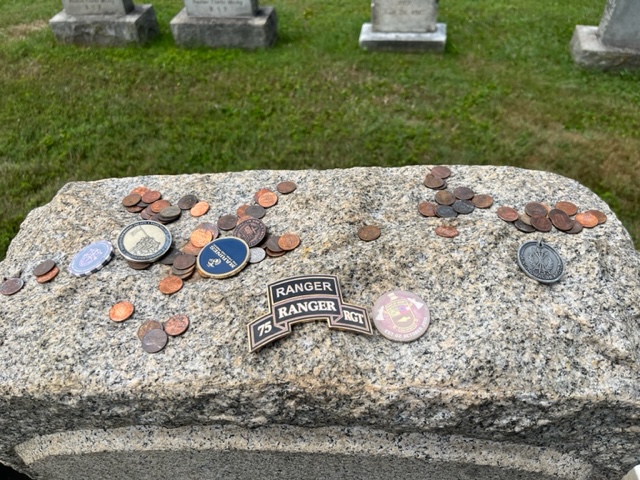
I concede that Mosby must have been an interesting man. In his biography of Ulysses S. Grant, historian Ron Chernow records the unlikely friendship that developed between Grant and Mosby.
During the war, Mosby and his men were such a menace that Grant once ordered that if any of Mosby’s men were captured, they were to be executed immediately, without trial. As a friend said recently, “He was great at what he did.”
But after the war, Grant came to Mosby’s aid when he issued a guarantee of safe conduct that allowed Mosby to travel and practice law. Mosby is said to have insisted on Black voting rights and once stopped a man who was clubbing a Black man trying to vote.
Grant called him an “honest, brave, conscientious man.” And on Grant’s death, Mosby said, “I felt I had lost my best friend.”

Still, when he was 28 and facing what would be one of the most important decisions of his life, Mosby chose wrong. He bore arms against his country. He spilled blood—his own and others’—in defense of a corrupt conviction.
After four years of war, he was unrepentant. He met with his soldiers in Fauquier in 1865 to disband the unit and told them, “The vision we cherished of a free and independent country has vanished, and that country is now the spoil of a conqueror.”
That vision of a “free and independent” country did not include Black people. It was the same vision that 15 years later insisted on Arthur Jordan’s lynching.
 Jim Hall